Wedding seating chart: how to seat your guests, step by step
A wedding seating chart — a seating plan, if that is the word you grew up with — looks like a drawing exercise: rectangles, circles, names. In practice it is a decision about who each of your guests spends the next eight hours with. That is why it is so hard to finish in one evening, and so easy to spoil with one person seated in the wrong place.
Below is the order that works: the room first, then the groups, then individual people. Doing it the other way round — starting from the guest list — ends in rewriting the whole thing.
1. Start from the shape of the room, not the guest list
The table layout decides how many seats you have at all and who can see whom. Three arrangements come up most often, and each has a different drawback:
- A horseshoe — the couple's table at the head, two arms down the room. Everyone can see you and everyone can see each other. The catch: you only ever talk to the two people beside you, because opposite is either empty floor or the far arm.
- Round tables — good for a shared conversation, because everyone at one table can hear each other. The catch: some guests sit with their backs to you and to the dance floor, so they turn their chairs.
- Long rectangular tables — they fit a narrow room and are easy to extend. The catch: a long table breaks into two separate conversations, one at each end.
Ask the venue for dimensions and for how many tables actually fit with gangways left clear. Reckon on about 60–70 cm of width per person, and a gangway wide enough for a waiter to pass behind a pulled-out chair.
Round tables or a horseshoe
Choose round tables when conversation in small groups matters most. Choose a horseshoe when you want most guests to see the couple and the shared centre of the room. Do not decide from an inspiration photo alone: ask the venue for both layouts with working gangways, and count the real seats before assigning a single name.
How many people fit at one table
| Table | Comfortably | Maximum | Note |
|---|---|---|---|
| Round, 150 cm | 8 | 10 | At 10 there is no room left for serving dishes |
| Round, 180 cm | 10 | 12 | Often found in wedding venues |
| Rectangular, 220×90 cm | 8 | 10 | Counting one person at each short end |
Calculate for your guest list
How many tables for a wedding — calculator
Enter your guest count and pick the tables your venue has. You get the number of tables and an even split, before you assign a single name.
You have the number of tables. Now the names.
In calm.wedding you paste your guest list in any format, assign guests to tables, and each guest then finds their own seat on their phone. Building the plan is free.
Seat your guests for free2. Seat people in this order
- The couple's table. Just the two of you, with the witnesses, or with immediate family — your call, but make it first, because it fixes the centre of the room.
- Parents and grandparents. Close to you, and never under a speaker. Older guests give up on conversation when they cannot hear it, and then they leave early.
- Groups who will arrive together anyway. Family, work, university, friends from the old street. Do not break them up “to mix people” — mixing happens at the bar, not at the table.
- People who know nobody. This is the only point where it is worth thinking about character: beside someone talkative, and not at the end of a table.
- Children. Either with their parents or at one shared table near the exit — you leave part-way through with a child, and you do not want to squeeze across the whole room.
3. Four situations that spoil a good plan
Divorced parents. What matters is the line of sight, not the distance in metres. Two tables side by side facing different ways works better than two ends of the room with a clear view of each other all evening.
Former partners in the same circle. Separate the tables but keep both people in the same group — moving someone in among strangers is more conspicuous than the adjacency itself.
Someone arriving alone. The worst seat is the end of a table next to a couple who came together. The best is the middle of a table with people of a similar age.
The speaker, the kitchen door and the door to the toilets. Three places nobody wants. Seat the people there who will spend most of the evening on the dance floor anyway.
4. When to make the plan
Realistically: two to three weeks before the wedding. Earlier is pointless, because confirmations arrive until the last minute. Later leaves no time to print.
And the thing few people warn you about: in the final week the plan will change once or twice more. Someone falls ill, someone brings a plus-one, someone cancels on the Friday evening. A plan that cannot be corrected after printing is a plan that is out of date on the day.
What to do when a guest cancels three days before the wedding
Remove only that seat first and check whether anybody is now stranded at the edge of the conversation. Do not automatically move every later place: one cancellation does not need to restart the whole puzzle. If the table has an obvious gap, move one person from the end towards the middle, replace that one place card and update the plan on guests' phones. Tell the venue and caterer separately; changing the seating chart does not update their numbers by itself.
5. Place cards, a board, or a phone
All three work and you do not have to choose one. They differ in what happens when the plan changes:
- Place cards on the tables — the prettiest and the most personal. A change means writing a new card, which can still be done on the morning.
- A board by the door — one for everybody, so a queue forms at it exactly when guests want to congratulate you. A change means a new print.
- The plan on a guest's phone — everyone sees their own seat without queuing, and a correction in the panel shows the next time they open the link. It does not replace place cards; it replaces the board and the question “where do I sit?”.
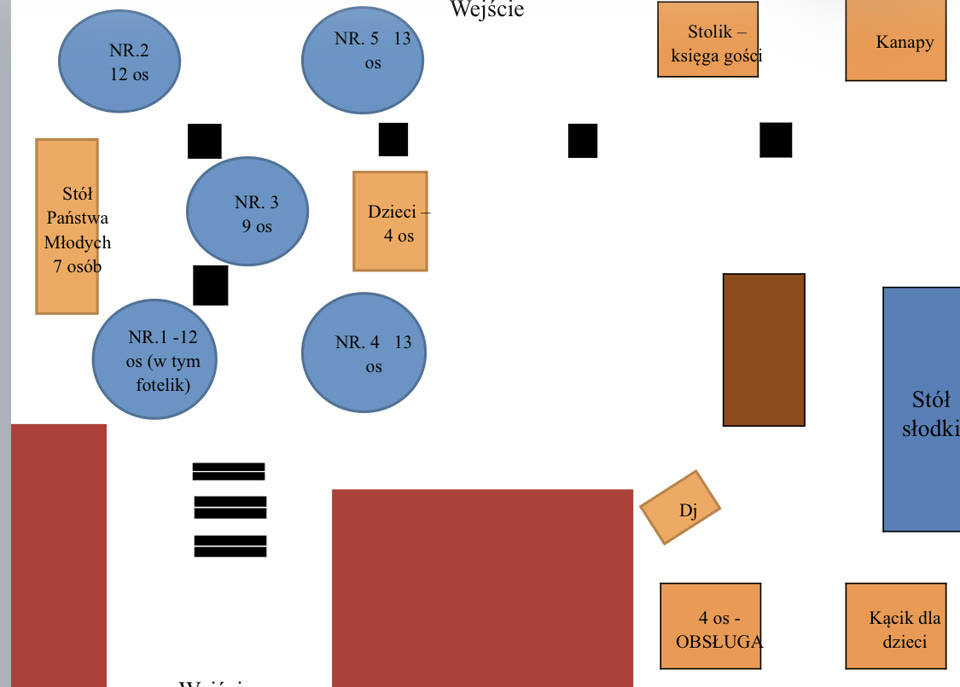
calm.wedding does that third part: guests scan one QR code, pick their name, and see their table, their neighbours, the running order and the site map. You correct the plan in the panel in a minute. Building it is free — you pay only when you want to send the link to your guests. Build your wedding seating chart free.
Common questions
Do you have to have a seating chart at all?
Under 40 guests and a buffet — no. At a wedding with dinner served to the table, a plan saves a quarter of an hour of milling about at the start and solves the problem of people who know nobody.
Who should sit at the couple's table?
There is no single rule. Most often the witnesses, sometimes siblings, increasingly the couple alone. It is worth asking the witnesses whether they want to sit there — for some people it is eight hours of official duty.
Can guests choose their own seats?
They can, if the room is small and everyone knows each other. At a larger wedding the free seats run out in a way that leaves the last arrivals sitting apart — usually the ones who came alone.
Next: the QR code at a wedding — where to put it and how to print it so it works →